
Poetics and Risk: Feeling into Being
4 February 2026
Following-Leading in Risk, A Supplement
5 September 2026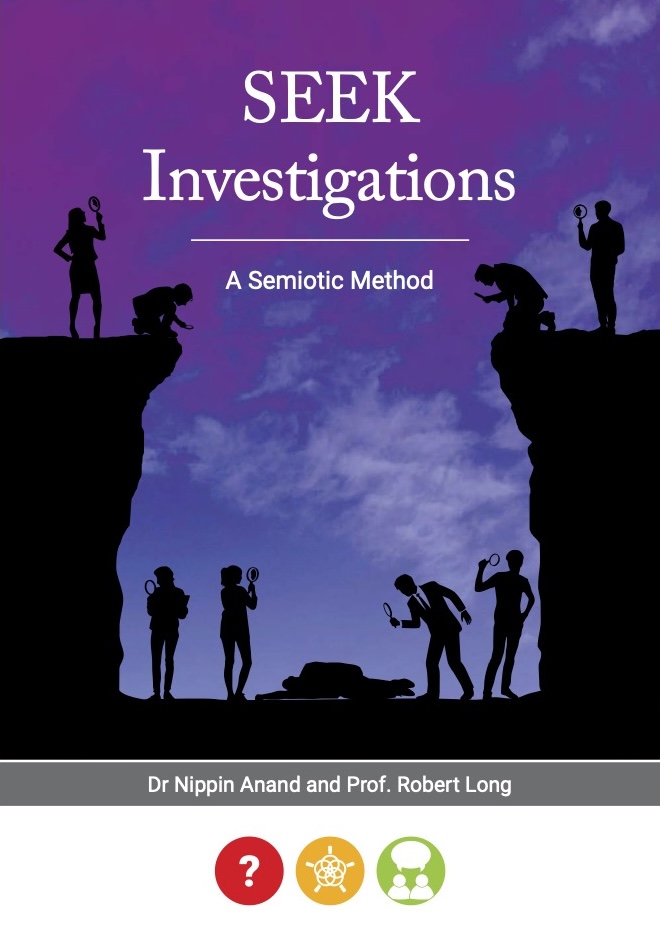
Seek Investigations: A Semiotic Method
AUD$0.00 Inc GST
This is the eighteenth publication in the series on the Social Psychology of Risk. It is the third book using a purple cover, intentionally linking to the books on following-leading and ethics. As usual, it is located on the theme of the chasm and has people in various poses either looking through a magnifying glass or looking in a mirror. This is critical to the symbolic nature of this book.
SEEK Investigations is not just about looking but also reflecting. In investigations, it is just as important how we look at ourselves before we investigate than it is to jump into putting an event under the magnifying glass. At the bottom of the chasm is an injured person, harmed in some way, but in reality, we really don’t know what condition they are in; it would be foolish to make an assumption about their condition. Whilst some people are in the chasm, some are above the chasm and thus have a different vantage point—this is critical.
We can only understand an event from where we stand, and this is the bias of the investigator. Whether male or female, this denotes the importance of social and cultural context brought to any investigation. The symbolism also brings into view the key questions: What are you looking at? and What are you looking for? This draws out the importance of semiotics in any process of investigation; indeed, without an understanding of semiotics, it is unlikely that any investigation could be holistic, comprehensive, or person-centric. This is where the nature of discovery, wonder, mystery, and enquiry rest in the acceptance of uncertainty in risk.
The greatest enemy of investigation is hubris, overconfidence, and anchoring to “tick and flick” templates designed by someone else. The magnifying glass and the mirror are symbolic in many ways: they amplify, reflect, can burn, can break easily, show up impurities, can reverse how we view something, they can zoom in, become a lens for envisioning, distort, and even warp our perspective. These are all relevant when we think of how philosophies determine method. In many ways, we investigate for what we are looking for and look for what we know, within the limits of what we know.
Related products
-
SPoR and Semiotics
AUD$0.00 Inc GST
